POV
October 26, 2026
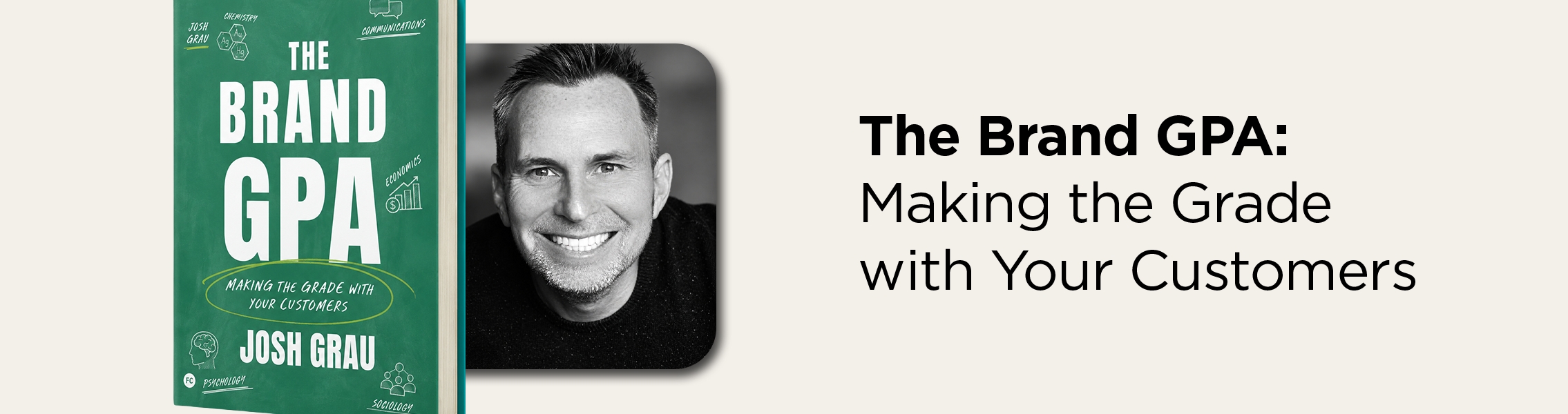
The Brand GPA: Making the Grade with Your Customers
Ask any CEO or founder if they want a great brand, and the answer is yes. Ask how they measure if it’s great or not, and things get awkward.
In The Brand GPA: Making the Grade with Your Customers (Fast Company Press, October 27, 2026), four-time CMO and former Twitter, YouTube, Wealthfront, and Yext executive Josh Grau argues that brand has a brand perception problem. That’s because it too often gets reduced to mean Super Bowl ads and new fonts and colors on the homepage, only relevant in times of strong tailwinds. Product growth expert Elena Verna puts it well: “Utility gets usage. Emotion gets loyalty.” Grau adds that utility plus emotion equals brand.
Yet Gartner finds that 84 percent of companies are caught in a “doom loop”: underfunded brand measurement leads to unclear impact, which leads to C-suite skepticism, which leads to tighter budgets. And let’s be honest: it also causes faster CMO churn.
Grau’s diagnosis is that companies are grading their own exams. Marketing celebrates a 40 percent email open rate, product high-fives twelve new features, and customer success rings the bell for 85 percent satisfaction. The internal dashboards are green — but the customer perception of the brand is blinking red. That’s because customers are grading on entirely different criteria, and they are very tough graders. So the fix starts with a mindset shift. Brand is not a hot potato to toss from marketing to product to whoever seems the most “guilty.” As Grau puts it, brand is “the whole damn meal,” and everyone who touches the customer shares accountability for it.
The Curriculum
The Brand GPA translates customer experience into a framework anyone has understood since high school. Five weighted subjects, each with three measurable sub-subjects, are scored from the customer’s point of view:
- Chemistry (30%) covers customer–brand fit: Activity, Affinity, and Retention. It carries the most weight because Retention is the greatest predictor of long-term profitability.
- Communications (20%) covers Clarity, Engagement, and Responsiveness across every touchpoint, not just the press release.
- Psychology (15%) covers how the brand makes people feel: Motivation, Personalization, and Control.
- Sociology (15%) covers how the brand engages with the world: Alignment, Advocacy, and Cultural Resonance.
- Economics (20%) covers Value Perception, Revenue Expansion, and Economic Efficiency. It comes last because the other four subjects feed directly into the bottom line.
The grading rubric is as you would expect, with one exception: an A earns a 3.8 instead of a 4.0. That’s deliberate, as Grau believes perfection is a fantasy when you serve millions of customers. In other words, excellence is possible, flawlessness is not. There are no pluses, minuses, curves, or extra credit. The math is bottoms-up, based on real, verifiable data, so no brand gets a high grade based on vibes.
Every brand in the book is graded over the same ten-quarter window, Q1 2023 through Q2 2025, using only metrics backed by two or more independent data sources and established benchmarks. The window is long enough to reward sustained performance and short enough to stay current. However, if you read about a brand today that you think is no longer earning a high GPA, that’s the thesis in a nutshell: nothing is guaranteed, so brands need all hands on deck, all the time.
Part One covers each subject of the Brand GPA in depth. Each chapter spotlights brands that are Making the Grade and Missing the Mark, crowns Top Scholars and Bottom Dwellers, and ends with a pop quiz so readers can start assessing their own brands.
The Report Card
Part Two looks at the whole curriculum in practice through two sets of report cards: the Valedictorians and the Comeback Kids. Twelve brands, one per industry, earn the title of Valedictorian for excelling across all five subjects. None earn that distinction from a single earnings boom, breakout launch, or viral social media moment. Each profile shows how the grade was earned, quarter after quarter, subject by subject. Who made the cut, and who sits just behind them as Salutatorian, is for readers to discover. So are the Struggling Students, a reminder that even household names can flunk when the fundamentals break down.
But a bad report card is not a life sentence. The Comeback Kids chapter profiles a dozen brands that turned their GPAs around. Because this kind of transformation takes time and patience, these brands are graded over a longer, five-year window from 2020 to 2025 — and each must show a clear decline, a meaningful rebuild, and a sustained recovery. The biggest improvement? A nearly flunked-out 1.1 to a rock-solid 3.3. Each brand featured is a case study in how to win back customers and brand love, one subject at a time.
Why The Brand GPA?
The book is designed for readers who take immediate action via the pop quizzes, which help them gather the numbers that matter — such as retention rate, CSAT, self-service resolution rate, a values Alignment survey result, and a price-to-value satisfaction score — and start to form a real picture of the health of their brand with the Brand GPA framework.
Grau tackles the “artificial elephant” in the room: AI. In a world of LinkedIn AI hot takes and companies rushing to implement new AI-powered software to become more efficient, he argues the signal is still the customer’s assessment of the brand, and the true top scholars will use AI to enhance the customer experience — not replace it. As he puts it, new technology waves will keep coming in, but one thing remains steadfast: customers expect an excellent experience, every time.
The Brand GPA is a multi-hyphenate. It’s a brand health diagnostic, a strategic planning framework, a shared scorecard, and a common language for measuring what customers actually care about, rolled into one score that is easy to track, defend, and act on over time. And while GPA traditionally stands for grade point average, Grau offers a second reading: Great Point Average. Because the goal isn’t just to assess a brand — it’s to make it really great.
Josh Grau
Author & CMO

Josh Grau has spent his career at companies that weren’t riding waves—they were making them. As a four-time CMO and former executive at Twitter, YouTube, Wealthfront, and Yext, he helped build the marketing foundations for the defining technologies—online video, social media, fintech, and AI—that fundamentally changed how people interact with brands.
At the same time, he’s watched even the world’s most iconic brands struggle to connect with the people who matter most: their customers. After two decades helping brands find the plot, he translated those experiences into The Brand GPA: Making the Grade with Your Customers—a guide for leaders who want to move their brands to the top of the class.
He has taught marketing and storytelling at Northwestern and Stanford, coached NCAA Division I volleyball, and advises companies at all stages of growth. He writes Shades of Grau on Substack, where brands, technology, and popular culture intersect—and sometimes collide. He splits his time between Austin and San Francisco.
Please login to join the discussion
Comments
No comments yet.